The lasagna problem: why your website has more technical debt than you think
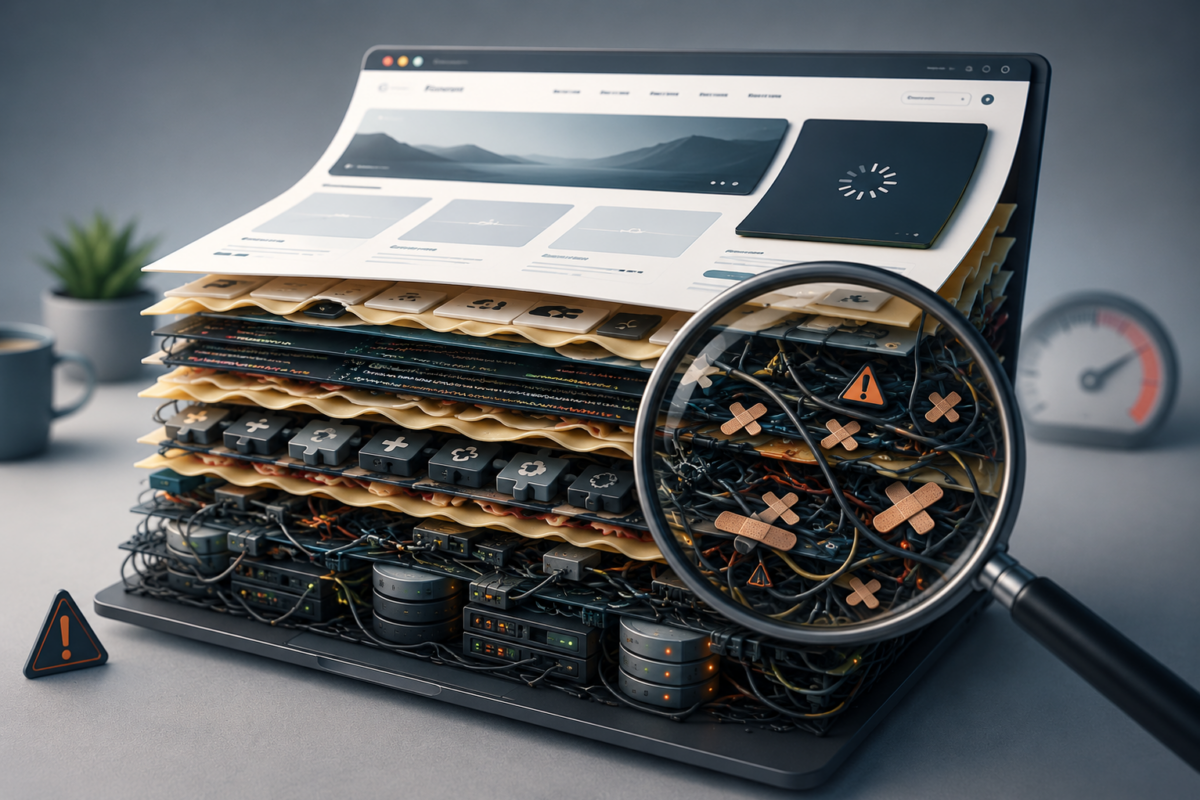

A real look at the trade-offs of using tools like Avada, Elementor and Divi
Site builders like Avada, Elementor and Divi have changed how people build websites. With sleek interfaces, visual editing, and a rich collection of pre-built components, they’ve made web design more accessible to everyone: no coding required.
But for organisations that need to meet high standards for accessibility, performance, visibility, and long-term success, the question isn’t just can you build a site with a site builder? It’s can you build one that everyone can use, that loads quickly, ranks well on Google, and grows with your organisation?
Let’s take a clear-eyed look at the trade-offs.
We get it. Site builders are easy. They make designing a website feel like putting together a PowerPoint slide. You pick a block, drop it in, adjust the colours, click publish. Boom, your website is live.
They’re great for:

For small teams, this kind of speed and flexibility can feel like a game-changer. But once you start making changes and use the website, the cracks begin to show.
And here’s the kicker: once you notice these issues, fixing them is often more complicated than building the site properly in the first place.
Accessibility means building websites that work for everyone, regardless of their abilities, devices, or internet speed.
It’s not just about checking if your font is big enough or adding alt text to images.
It’s about:
If that sounds technical, it is. But it’s also essential. Because if someone can’t use your site, they can’t access your services, apply for funding, find resources or engage with your message.
For sectors like health, education and government, this isn’t just best practice. It’s often a legal requirement.
Attention spans are short. If your site takes longer than a few seconds to load, people leave.
Site builders often load:
All of this adds up to a slower, clunkier experience. Not only does it frustrate users, it affects how search engines view your site. Slow sites drop down the results list. Your amazing content? It’s buried.

When we build websites, we aim for clean, semantic code. You can say we are performance and best practice obsessed.
That means:
This isn’t just a developer’s obsession. Clean, semantic code creates measurable improvements in three key areas:
According to WebAIM’s research, proper heading hierarchy and ARIA attributes significantly improve screen reader navigation. Home pages with ARIA present but improperly implemented had 70% more detectable errors.
Clean code without unnecessary div structures and excessive JavaScript improves Core Web Vitals metrics, which Google confirms are ranking factors.
Recent performance tests comparing site builders showed custom-coded solutions reduced average load time by over 50% compared to popular site builders.
When evaluating WordPress editors, Gutenberg offers significant performance advantages over traditional site builders. A 2020 performance comparison by GutenbergHub showed that Gutenberg-built pages were substantially smaller in size (24.9KB vs. 400-700KB) and required fewer HTTP requests (8 vs. 15-36) compared to popular site builders like Elementor and Divi, resulting in faster load times.
Why? Because it gives our clients the best of both worlds:
No messy design choices. No broken layouts. No guessing.
Our editors get exactly what they need: intuitive blocks for common content types, styled correctly, accessible by default, and scalable across the site.
These projects often start with a question like:
“Why is our site so slow and hard to use?”
And end with:
“I can’t believe how easy this is to manage now.”
A lot of people think SEO is about keywords. But when it comes to site builders, three critical factors matter more:
Site builders load unnecessary code that slows down your site dramatically. WP Rocket’s 2025 testing shows Elementor and Divi pages load in 2.7-2.9 seconds, while custom solutions load in under 1.6 seconds.
This matters because Google’s Core Web Vitals are direct ranking factors. According to the same study, Elementor scored 75/100 on mobile performance while Divi scored just 64/100. Both popular builders fail Google’s recommended 2.5-second threshold for Largest Contentful Paint.
Behind every beautiful site builder page is excessive HTML that confuses search engines. The WebAIM Million Report found the average webpage contains 1,257 elements (a 7.1% increase from 2023), with site builder pages typically containing even more.
Additional testing by GutenbergHub found that Elementor pages had nearly twice as many HTTP requests as Gutenberg pages, with significantly larger page sizes. This excessive code dilutes your content’s relevance signals.
With Google’s mobile-first indexing, site builders face a significant disadvantage. Their JavaScript-heavy approach creates poor mobile experiences with layout shifts, slow load times, and resource-intensive pages.
Backlinko’s research confirms that pages failing Core Web Vitals metrics are significantly less likely to achieve top rankings, while a Search Engine Journal analysis emphasizes how site builders’ complex HTML markup creates particular challenges for mobile optimization.
Put simply: an accessible, well-structured site is an SEO-friendly site.
When you build with clarity, inclusivity, and performance in mind, you’re not just ticking boxes. You’re giving your site the best chance of being found and used.Click here to learn more about boosting your site’s SEO.
Consider a site builder when:
Invest in a custom approach when:

If you’re using a site builder now, we’re not here to shame you.
But if you’re:
…it might be time for an audit.
We offer in-depth reviews that highlight what’s working, what’s not, and where things can be improved, all with clear, human language and practical steps.
And when it’s time to rebuild?
We’ll do it with:
WebAIM’s 2025 Million Report: Found that 96% of home pages have at least one WCAG accessibility error, with complex pages containing significantly more issues. Accessibility experts note that pages with many dynamic elements are particularly problematic.
Performance Testing: In comparative testing by GutenbergHub and WP Rocket (2024-2025), site builder pages consistently showed larger page sizes, more HTTP requests, and slower load times than custom-built solutions:
| Metric | Elementor | Devi | Custom Gutenberg |
| Page size | 940KB | 874KB | 300-400KB |
| Load time | 2.7S | .9S | 1.5-1.8S |
| Mobile score | 75/100 | 64/100 | 90+/100 |
A great website should work for everyone, including your team, your audience and your future.
READY FOR A WEBSITE THAT ACTUALLY WORKS?
If your website is central to your organisation’s mission, it needs to be fast, accessible and built to last. We’ve delivered high-performing, inclusive sites for some of Australia’s most trusted organisations and we’d love to help you do the same.

Book your FREE clarity call
Not Feeling Chatty
Fill in our project planner